
“Humphrey Humpkick”
Bronze 2025
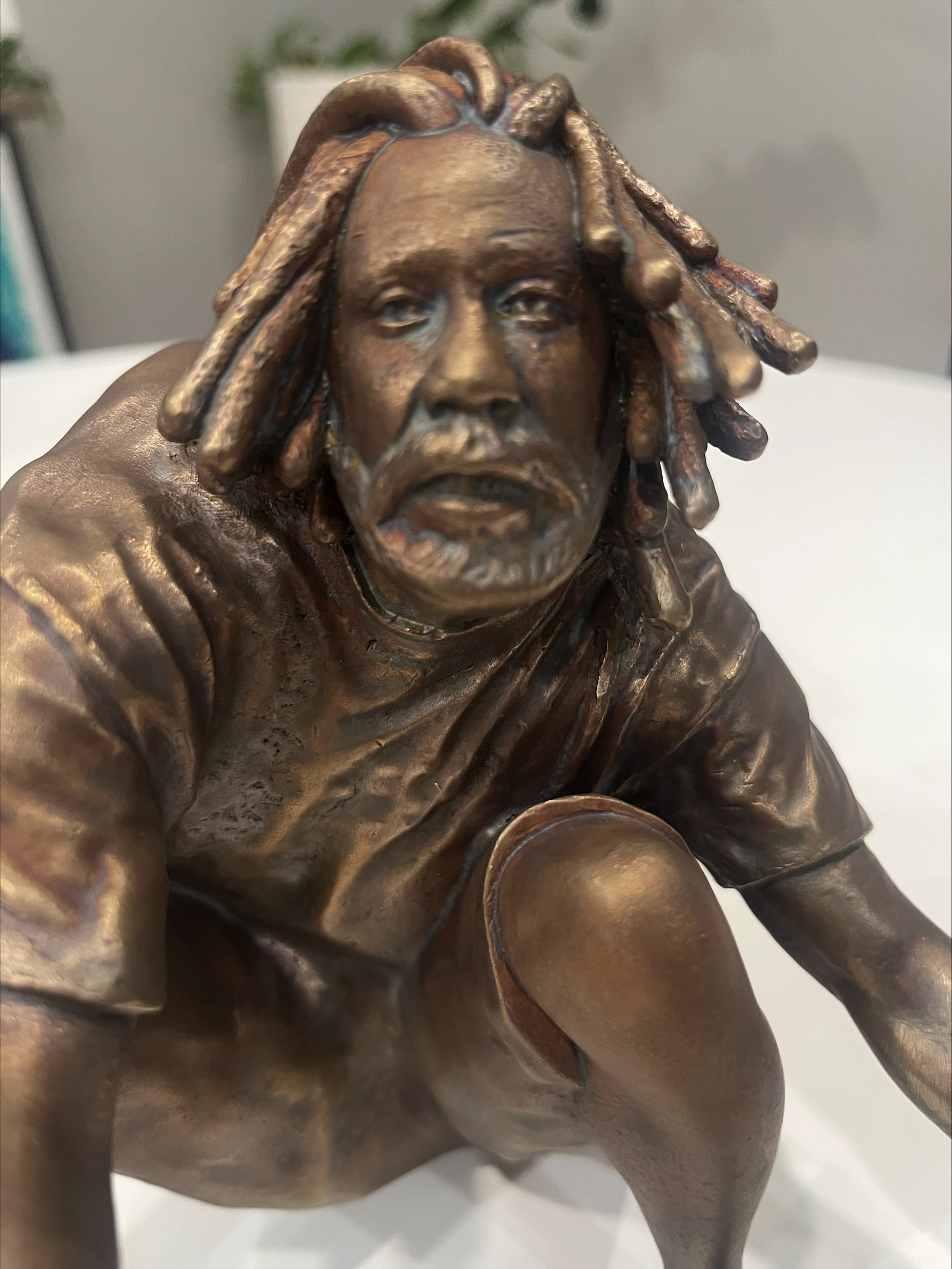
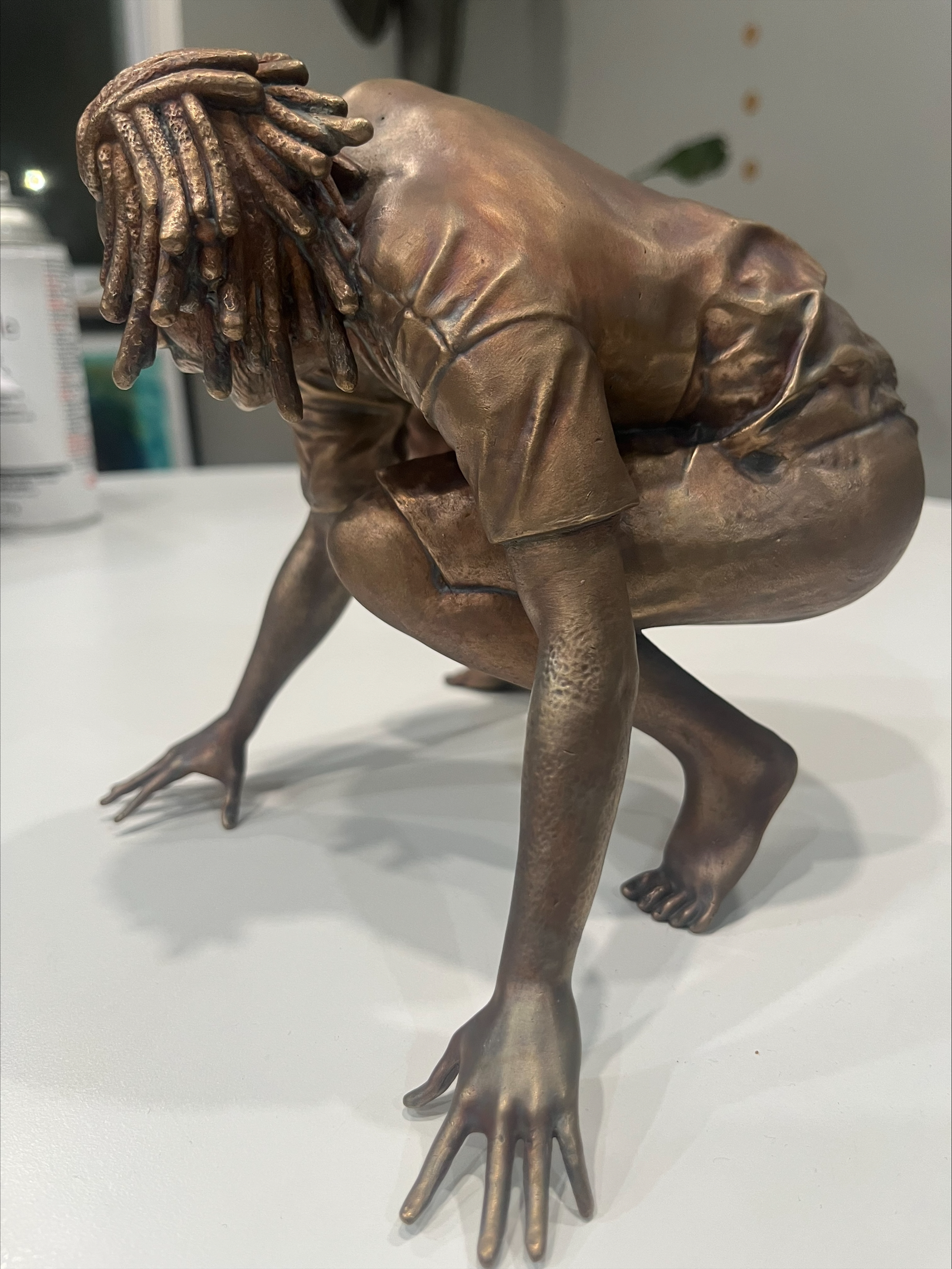
Humphrey is a character that has existed within my practice—and within myself—for over two decades. His presence marks the first time I understood storytelling as a form of artistic inquiry. Created in 2005, Humphrey became both a psychological refuge and a conceptual framework through which I could examine identity, projection, and the social conditions that shape how bodies move through public space.
The character emerged during my early years in Philadelphia after I experienced two separate physical assaults in public. These events forced me to confront the vulnerabilities and assumptions attached to my physical presence as a tall Black man navigating urban space. In response, I developed a performative strategy of protection and transformation. With four collaborators, I created Mute-N-Heard—a collective performance project in which we embodied green-painted characters derived from Humphrey and silently traversed public environments including Times Square, Philadelphia, Germany, and Hawai‘i.
Each participant constructed a character that externalized internalized burdens—racism, marginalization, insecurity, sexism, beauty standards, and mental health struggles. Through silent public performances, these figures became vessels for unburdening experiences that had previously remained internalized. The act of walking, witnessing, and being witnessed allowed us to release emotional weight through performance.
Humphrey himself became a physical manifestation of how I felt I was perceived in public space. By altering my body—painting my skin green, wearing a humpback, and reducing my stature from 6’3” to 5’5”—I intentionally distorted my physical identity. Yet the public response was not one of fear or hostility. Instead, strangers offered flowers, ice cream, and enthusiastic photographs. The stark contrast between the reception of Humphrey and the daily micro- and macro-aggressions I experienced as myself revealed a profound paradox: humane treatment became accessible only through disguise.
In 2024, I began reviving Humphrey as an act of reflection and acknowledgment. It took two years to regrow and reattach my locks in preparation for the character’s return, a process that often felt like method acting. During this period, I was reminded how quickly external projections re-emerge when physical presentation changes. What once felt burdensome became easier to disregard, yet it reaffirmed how powerfully appearance shapes social response.
Within this body of work, fragile collage elements mirror the vulnerability of youth and the emotional exposure embedded in the project. Layers of material function as both protection and revelation—echoing the layers we construct to shield ourselves while simultaneously revealing the impact of lived experience.
Humphrey is not a reflection of how I see myself, but rather an embodiment of how I felt others perceived me. Born from projection, the character now returns through projection, large-scale installations and projection mapping that translate personal narrative into collective viewing experiences. The medium becomes both metaphor and mechanism.
Humphrey’s story affirms a central truth within my practice: ideas do not disappear. They evolve, adapt, and re-emerge as technologies and perspectives change. What began as a survival mechanism has become an archive of performance, memory, and transformation.